

When stress sets in, it is common to seek to calm down by thought: reasoning, relativizing, analyzing. However, chronic stress is not primarily a problem of logic or will. It is a physiological state. Breathing is one of the few voluntarily accessible levers that allow direct action on this state. Scientific studies confirm today that a few minutes well used are enough to modify the inner state, without particular mental effort, by directly influencing our nervous system.
Why does breathing influence stress?
Our autonomic nervous system constantly regulates the balance between activation (vigilance, action) and recovery (rest, digestion). When stress becomes chronic, activation takes over. Breathing, often short and rapid, then maintains this state of alert, maintaining high levels of cortisol, the stress hormone.
Conversely, slower, regular breathing, with elongated exhalation, sends a physiological safety signal to the brain via the vagus nerve. This major nerve, which connects the brain to our organs, is the key to our relaxation system. By stimulating it with controlled breathing, we inform our body that it can release the tension and activate the “Recovery” mode.
Who is this practice for?
This practice is particularly suitable if you feel:
- Persistent mental agitation
- A feeling of internal pressure
- Diffuse body tensions
- Difficulty slowing down at the end of the day
- Sleep disturbed by stress
It does not replace any medical follow-up, but constitutes a simple and powerful tool for daily regulation.
Cardiac coherence: where does this concept come from?
The term “cardiac coherence” is not a commercial label, but a scientific concept identified and formalized by researchers at the Heartmath Institute in the 1990s. To understand this concept, you must first grasp what heart rate variability (VFC) is.
Heart rate variability: the scientific basis
Contrary to what one might think, a “healthy” heart does not beat at a perfectly regular pace. There is a natural variation between each beat, measured in milliseconds. This variation is called heart rate variability (VFC). It reflects the ability of the autonomic nervous system to adapt the heart rate in response to internal and external stimuli.
When we are stressed or on alert, this variability decreases: the heart beats faster and more rigidly. Conversely, when we are calm and in recovery, the VFC increases, the heart finds a certain flexibility in its rhythm.
Cardiac coherence: system synchronization
Cardiac coherence is a particular physiological state where the variability of the heart rate takes a very harmonious and regular form. It is a synchronization between several systems of the body: breathing, heartbeat, cerebral rhythm and hormonal response. According to Heartmath researchers, this state “is characterized by a relatively harmonious signal (sine wave-shaped) with a narrow peak and high amplitude”.
It is not a marketing invention, but a precise description of a measurable and reproducible state. The researchers discovered that this state can be self-generated by simple breathing practices, and that it produces concrete effects on mental stress, emotional balance and even physical stability.
Why 6 breaths per minute?
The number “6” is not arbitrary. At a frequency of 6 breaths per minute (i.e. about 5 seconds of inspiration and 5 seconds of exhalation), the nervous system reaches an optimal point of balance. At this rate, the oscillations of the heart amplify and become more regular, effectively activating the parasympathetic system. It is a frequency that has emerged from decades of research in physiology and biofeedback.
Anti-stress breathing in 5 minutes
Research has shown that even brief breathing practices can improve mood and significantly reduce anxiety. Here is a simple exercise based on a prolonged expiration to effectively activate the parasympathetic system.
1. Installation (1 minute)
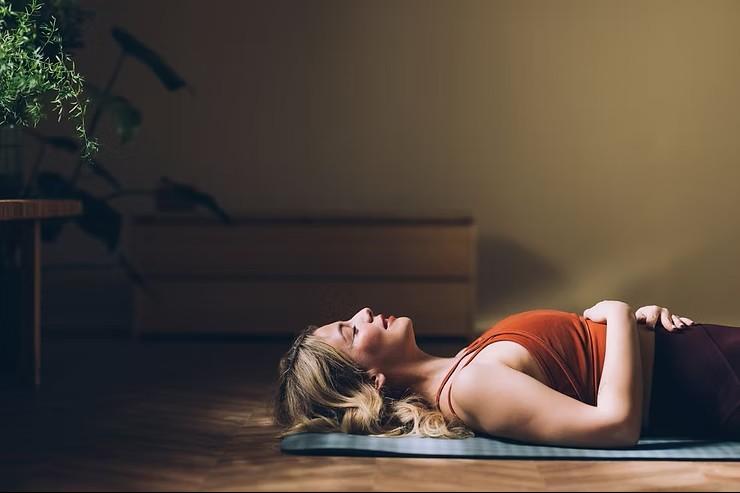
Sit on a chair with your back straight but without stiffness, or lie down comfortably. Take a few seconds to feel the weight of your body, the points of contact with the support and the stability of your posture. There is nothing to succeed, simply to be present.
2. Slow and regular breathing (3 minutes)
- Inhale through your nose for 4 seconds, calmly.
- Exhale through the nose or mouth for 6 seconds, letting the breath come out without forcing.
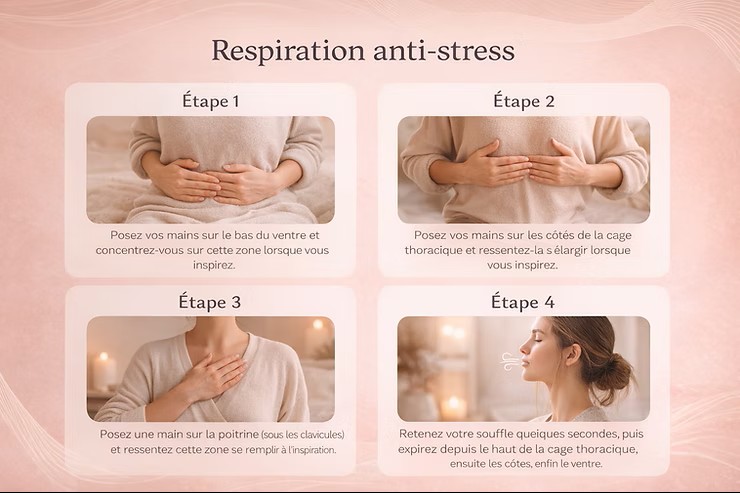
Expiration slightly longer than inspiration is a powerful signal to activate the mechanisms of nervous system recovery. Let the breath become fluid. If this rhythm seems uncomfortable to you, adapt it (for example, 3 seconds of inspiration and 5 expiration) without ever forcing.
3. Body Anchor (1 minute)
At the end of the 3 minutes, without modifying the breath, pay your attention to the bodily sensations: the belly that relaxes, the chest which calms down, the shoulders which become heavy. Just let the body incorporate the benefits of this break.
What you can feel
The effects vary from person to person. You could observe a progressive calming, a feeling of warmth, or a slowdown in the flow of thoughts. Sometimes the changes are not immediate. The absence of a strong sensation is not a failure. The effects of breathing are often progressive and cumulative.
When to practice?
This breathing can be used at any time to create a pause and regulate your condition:
- At the end of the day to mark a transition to a rest time.
- Before bedtime to make it easier to fall asleep and reduce rumination.
- During a break at work to release the pressure.
- After a stressful situation to help the nervous system return to balance.
Conclusion
Calming the nervous system does not always require long or complex practices. Five daily minutes of conscious breathing are often enough to tangibly change the inner state. At the beginning of the year, consider this practice not as a slowdown, but as the construction of a base of stability on which the momentum of the year can rely with more serenity and strength.
Références
[9] HeartMath Institute. (2022 ). What is Heart Coherence?
[11] Balban, M. Y., et al. (2023 ). Brief structured respiration practices enhance mood and reduce physiological arousal. Cell Reports Medicine, 4(1), 100895. https://www.cell.com/cell-reports-medicine/fulltext/S2666-3791(22 )00474-8